
Part I
Start with the plant, not the market. Electricity as an operating exposure, the true baseline, and why the load profile is the real commodity.
Publication
A buyer-side handbook on industrial electricity procurement, PPAs, and the Mexican Wholesale Electricity Market. Written for the people accountable for electricity inside an industrial business, it sets out procurement as a management discipline with its own baseline, controls, and calendar.
Free to qualified industrial and commercial energy buyers. Business email required. 409 pages, PDF.Inside the handbook
Three spreads from the 409 pages. Every figure is labeled as official data, an MEP analytical framework, or an illustrative case, with its source and its as-of date under the caption. The whole book is written to that standard.

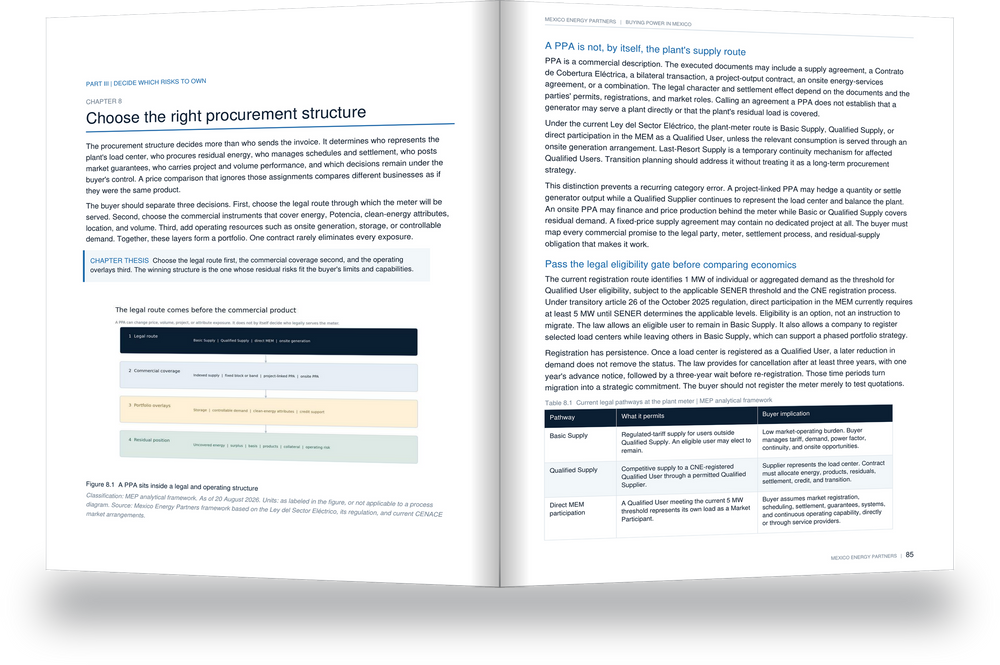

Pages shown as published. Data current to 20 August 2026.
Each chapter explains the market mechanism, identifies what can go wrong, and closes with a practical control. The edition closes with the MEP buyer toolkit, a procurement system in 26 pages.
Start with the plant, not the market. Electricity as an operating exposure, the true baseline, and why the load profile is the real commodity.
See the market from the meter outward. How electricity reaches the plant, why the generator price is not the plant price, and the charges beyond energy.
Decide which risks to own. The buyer's natural short position, choosing the procurement structure, and pricing flexibility.
Create competition and expose the real economics. An RFP suppliers cannot manipulate, normalizing every offer to the meter, counterparty risk in the price.
Contract for what can actually happen. From commercial model to contract, legal review as buyer protection, negotiating the downside first, signing versus supply commencement.
Protect value after signing and build a professional procurement function. Invoice reconstruction, living contract management, demand flexibility, clean energy without a marketing claim, governance, management information, and the procurement calendar.
The disciplined buyer does not need to predict the market perfectly, only to prevent unacceptable outcomes, preserve useful options, and verify that the contract performs as represented.
Authored in the firm's institutional voice. Every visual is identified as official data, an MEP analytical framework, or an illustrative teaching case. The legal and factual record closes on 20 August 2026.
Request a copy
The handbook is provided to finance, procurement, legal, engineering, and sustainability professionals evaluating electricity supply decisions in Mexico. Enter a business email and an MEP advisor will send you the handbook. If a question in it applies to your facility, an advisor can walk through it against your own bills.
The handbook is a commercial and operational guide, not a legal opinion, tax advice, an accounting determination, engineering certification, or an offer to buy or sell electricity.